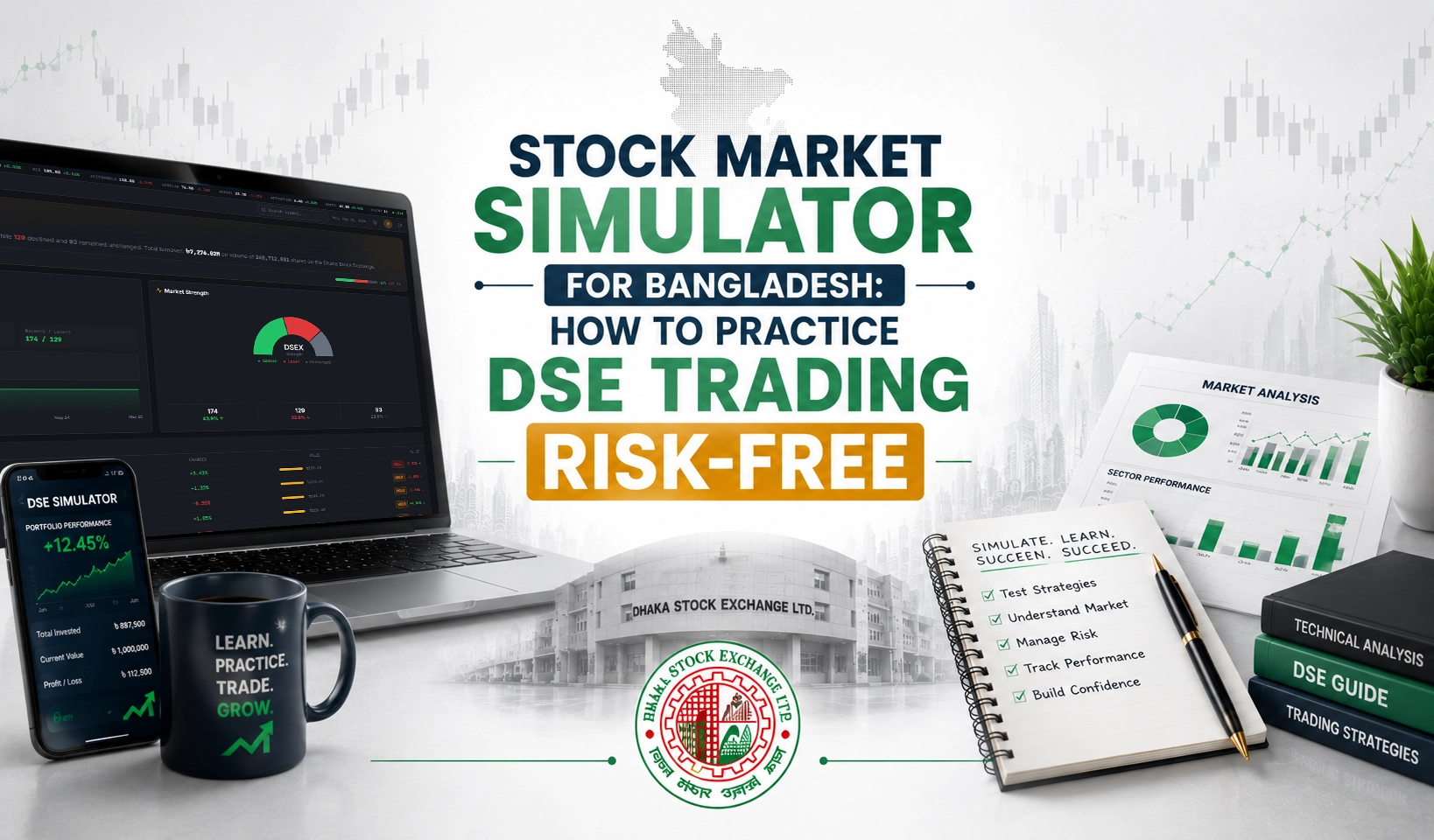
Stock Market Simulator for Bangladesh: How to Practice DSE Trading Risk-Free
Why Practice Before You Trade for Real?
Opening a BO account, depositing money, and buying your first stock on DSE feels exciting — until the price drops 8% the next day and you realize you bought on a hunch, not a plan. Paper trading lets you make those mistakes with fake money instead of real savings.
A stock market simulator mirrors live market prices but trades with virtual currency. You place buy and sell orders, track a portfolio, and see how your picks perform — all without risking a single taka. For new DSE investors, this is the single best way to build confidence before going live.
What Is Paper Trading?
Paper trading means buying and selling stocks with simulated money instead of real capital. The name comes from the old method of writing trades on paper to track hypothetical returns. Modern simulators connect to live market data, so the prices you see and the orders you place reflect real market conditions.
The point is simple: learn the mechanics of order placement, settlement, and portfolio management before your money is on the line. On DSE, where circuit breakers can halt a stock for the day and settlement takes T+2 business days, understanding how things work before you commit real funds makes a real difference.
DSE-Specific Simulators Available Now
Most global stock simulators (like Investopedia's or TradingView's paper trading) focus on US or Indian markets. They don't cover DSE stocks, don't follow Bangladesh trading hours (Sunday through Thursday, 10:30 AM to 2:30 PM BDT), and don't simulate DSE-specific rules like circuit breakers and T+2 settlement. These DSE-focused options do:
1. SkillDash
SkillDash is a free browser-based simulator built specifically for DSE. You start with 10,000 virtual BDT (called Coins, where 1 Coin = 1 BDT) and can trade 300+ DSE-listed stocks. It mirrors real DSE rules: T+1 settlement (you can't sell on the purchase day), 0.3% broker commission, and Bangladesh market hours and holidays. It also includes leaderboards so you can compare your performance against other traders.
Best for: Beginners who want the most realistic DSE trading experience without spending anything.
2. VSTOCK by CAL Bangladesh
VSTOCK gives you BDT 1,000,000 in virtual funds and mirrors live DSE prices. It includes portfolio tracking, trading challenges, leaderboards, and a community of 1,000+ traders. Run by CAL Bangladesh, a brokerage firm.
Best for: Traders who want a larger virtual bankroll and community competition features.
3. Duty AI: Dhaka Stock Exchange
Duty AI is an Android app (10K+ downloads) with paper money trading, portfolio tracking, a stock screener, and AI-powered stock alerts. The paper trading module lets you practice with virtual money while the AI features help you identify potential trades.
Best for: Mobile-first traders who want AI alerts alongside their practice trades.
4. Biniyog Paper Trading
Biniyog offers a virtual trading account with a progressive learning path: Apprentice, Practice & Analysis, Capital Market Investment, Expert Trader. It also provides real BO account opening when you're ready to go live.
Best for: Structured learners who want a step-by-step progression from beginner to real trading.
What Simulators Can't Teach You
Paper trading has clear limits. The biggest one: fake money doesn't trigger real emotions. When ৳50,000 of virtual money drops 15%, you shrug it off. When it's your actual savings, you panic-sell or hold too long. Simulators also can't replicate slippage (the gap between your order price and the executed price on low-volume DSE stocks), order queue delays, or the experience of watching your stock hit the upper circuit with unfilled buy orders beneath you.
Treat a simulator as a practice ground for mechanics — order placement, portfolio management, testing entry and exit strategies — not as a predictor of real returns.
How to Get the Most Out of a Simulator
If you're going to practice, practice well. Here's what actually helps:
- Start with a realistic amount. Don't use the ৳1,000,000 virtual balance if you plan to invest ৳50,000 in real life. Reset your account to match your actual budget.
- Track every trade. Note why you bought, your target price, and your stop-loss level. This builds a trading journal habit that pays off when you switch to real money.
- Practice the full cycle. Buy, hold for your intended period, and sell — don't just day-trade. On DSE, with T+2 settlement, holding periods matter.
- Test strategies, not stocks. The goal isn't to find the one stock that goes up in the simulator. It's to see if your strategy (momentum, value, dividend-focused) works consistently across multiple picks.
- Use real tools alongside. Pull up StockAI Live's screener to filter stocks by P/E, volume, or sector, then add your picks to a watchlist to track them alongside your simulator portfolio.
Using StockAI Live as a Trading Practice Tool
StockAI Live isn't a simulator, but it pairs well with one. Here's how to combine them:
- Screener → Simulator: Use the stock screener to filter DSE stocks by sector, P/E ratio, volume, or price range. Pick your candidates, then execute those trades in your simulator.
- Watchlist → Tracking: Add your simulator picks to a watchlist on StockAI Live. You'll see real-time price updates, AI trading signals, and circuit breaker alerts alongside your simulated portfolio.
- Signals → Validation: Check the AI trading signals (RSI, MACD, Bollinger Bands, Vegas Tunnel, Fibonacci) for stocks you're considering in the simulator. See if the technicals line up with your thesis before you commit real money.
When to Move From Simulator to Real Trading
There's no magic number of simulator trades that qualifies you for the real market. But these signs suggest you're ready:
- You've completed at least 30 trades across different market conditions (up days, down days, sideways weeks).
- Your simulator portfolio is profitable over a 2-3 month period, and you can explain why — not just that you got lucky on one stock.
- You understand T+2 settlement, circuit breakers, and how order types work on DSE.
- You've developed a consistent strategy with clear entry and exit rules — and you follow it, even when your emotions say otherwise.
- You can afford to lose the money you're putting in without it affecting your daily life.
When you're ready, open a BO account with a DSE-member brokerage, start small, and apply the same discipline you practiced in the simulator.
Frequently Asked Questions
What is the best stock market simulator for DSE?
SkillDash is the most realistic free DSE simulator — it mirrors T+1 settlement, broker commissions, and Bangladesh market hours. VSTOCK by CAL Bangladesh offers a larger virtual balance (৳1,000,000) and community leaderboards. For mobile, Duty AI provides paper trading with AI-powered stock alerts.
Is paper trading the same as real trading?
Mechanically, yes — you place buy and sell orders at live market prices. Emotionally, no. Fake money doesn't trigger the fear, greed, or panic that real savings do. Slippage on low-volume DSE stocks, order queue delays, and circuit breakers also behave differently with real money. Treat simulators as a way to learn mechanics and test strategies, not as a predictor of actual returns.
Can I practice DSE trading without money?
Yes. Free simulators like SkillDash and VSTOCK let you trade with virtual money using live DSE prices. You can also use StockAI Live's watchlist to track stocks you're interested in, monitor their prices and signals, and build conviction before opening a real BO account.
How long should I paper trade before using real money?
Aim for at least 2-3 months and 30+ trades across different market conditions. The goal isn't a specific win rate — it's demonstrating that your strategy has an edge and that you follow your own rules consistently. If you find yourself abandoning your plan on every down day in the simulator, you're not ready for real money.
What DSE-specific rules should a simulator include?
A good DSE simulator should include: T+2 settlement (you can't sell on the purchase day), circuit breakers (price limits that halt trading for the day), Sunday-Thursday market hours, Bangladesh bank holidays, and realistic broker commissions (0.40-0.60% per trade on DSE). SkillDash includes all of these.
Does StockAI Live have a trading simulator?
StockAI Live doesn't have a built-in simulator, but its stock screener, AI trading signals, and watchlist work well alongside simulators like SkillDash. Use the screener to find stocks, the watchlist to track your picks, and signals to validate your trading thesis — all before committing real money.